09/07/26

Another long day and night coring. We started at 6pm and finished around 5am. We put down five deployments, but only collected about 10cm of sediment from one core. The MC struggled to get good samples due to the seafloor being tough and full of beds of mussels. Some of our sites were pretty shallow, so the turnaround time was pretty fast, which was also exhausting. The last deployment was just a visual survey with the cameras attached to the MC so we didn’t actually core. The visual survey was of new grounds that hadn’t yet been explored, so that was exciting. We saw a lot of sea creatures including, anemones, various fish, squid, skates, and an octopus.

Kaustubh Thirumalai
09/06/26

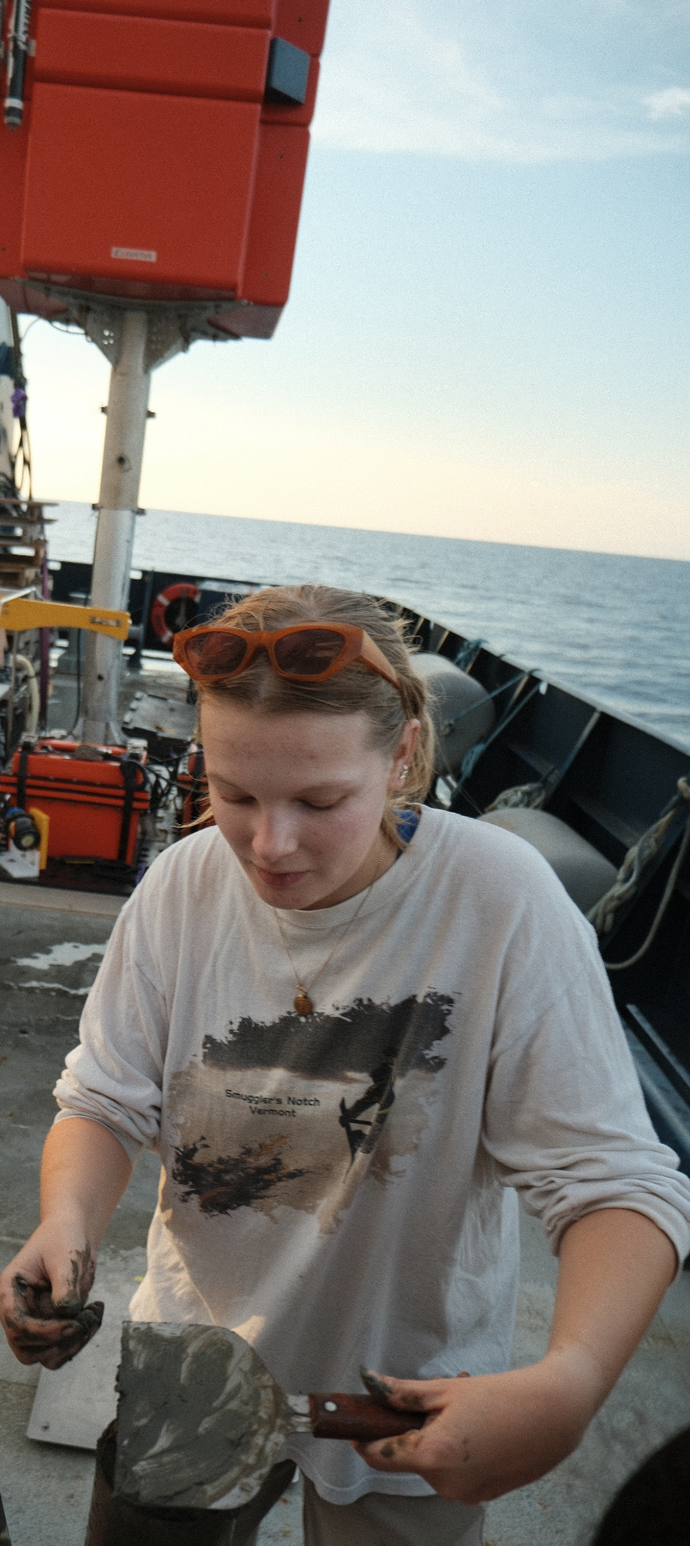
Today was a long day (and night). We finally got to core! We had to start coring as soon as Alvin got on deck and was put away. We went to the sites we had picked out a couple days before. There was a strong current today, making it tough to get the multicore to land properly. The first deployment was a bust, we couldn’t get the instrument to trigger, allowing the feet of the tubes to close. We realized that since the current was so strong, we needed to give the instrument more cord and hope that it wouldn’t wrap around the MC. We also figured out that we needed to adjust the speed at which we were pushing the corer into the sediment and the speed at which it was brought back up. After this, we had four good deployments, getting mud each time. This led to us slicing a lot of mud. We had so much sample that we had to throw some of it back into the ocean. We got pretty efficient by the end of the night when it came to tag lining, collecting water samples, and bagging sediment. Me and another grad student continued to process the cores while the two PIs worked on deploying the MC for another group of cores. We repeated this process over and over again with very little breaks. Some of the cores were challenging to process as they would get stuck on the stand that you place the core on to slice it. At one point, three of us were working together to push the core down. By 5:30am we were done, and I was very sore and tired.

Kaustubh Thirumalai
09/05/26

Today had a frustrating start because our coring date was pushed back again. This meant we needed to continue washing all the samples from the previous cores in the meantime. Luckily, we were able to wash the rest of our samples by the end of the day, giving me time in the evening to work in the library and watch a movie with friends in the TV room. 

Everyday we have a science meeting in the library at 6:30pm to talk about tomorrow’s plans and  the Alvin dive results from that morning. Today was especially exciting because they found temperatures of fluids coming out of methane seeps that were thought to be thermodynamically impossible! More research needs to be done on the ship to figure out more about the dive team’s findings.

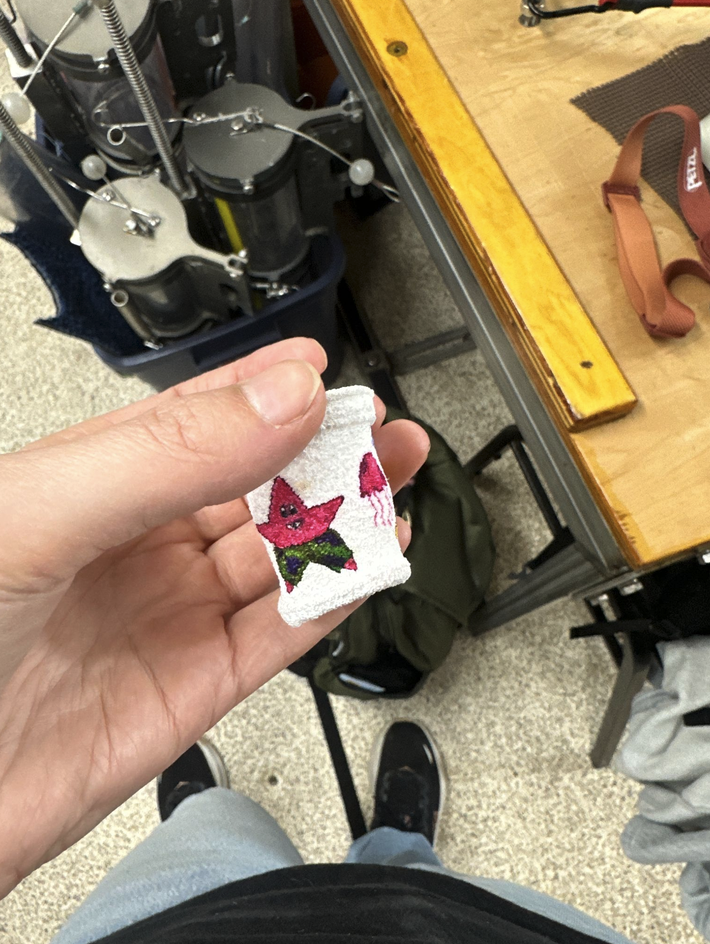
Some of us drew silly pictures (mainly nautical themed) on styrofoam cups that were then placed in Alvin. They shrink when they are brought to depth, so we each get a tiny cup that has been to the bottom of the ocean! I made mine Spongebob themed…

Kaustubh Thirumalai
09/04/26

I haven’t done a whole lot in the past couple of days. There have been some kinks in the cruise plan, so we have been on the same site for a while. The Lander (which holds some science equipment at the bottom of the ocean) got stuck and wouldn’t come up when it should have. This meant we had to send Alvin down to bring it up manually, which was time consuming. Since the Lander was down for so long, the samples were ruined and needed to be tried again. 

While I am waiting for the next core site, we are continuing to wash mud from the two cores we do have. It has been complicated though because we learned we can’t dump dirty water overboard if we are on the CTD site as we have been doing in case it ruins samples. So we have to find pockets of time in transit to dump. Luckily, we got a huge trash can that we can wash samples over for now so our buckets don’t fill as fast. Unfortunately, the methane seep samples are stinky and attract a lot of flies…

Since we aren’t finding many foraminifera in our seep site, we decided we should move locations for the next core. Sitting down with the rest of the team to decide where to core was really interesting. We needed to find a transect that was in just the right spot. Somewhere close to a methane seep, where we could then core progressively away from the seep and also get a background site nearby. On top of that, we need to make sure that the sites are in areas where we will likely get foraminifera, not too deep, too shallow, too cold, etc. Hopefully we found just the right spot to try coring tomorrow night if everything goes to plan.

Once the sun set and we were able to dump some muddy water, the fly situation got better (but not great). We were able to wash more samples on deck listening to music. While we were washing, someone showed us the squid that unfortunately got stuck in Alvin, before tossing it overboard.

Washing sediment and waiting for it to dry.

Kaustubh Thirumalai
09/01/26

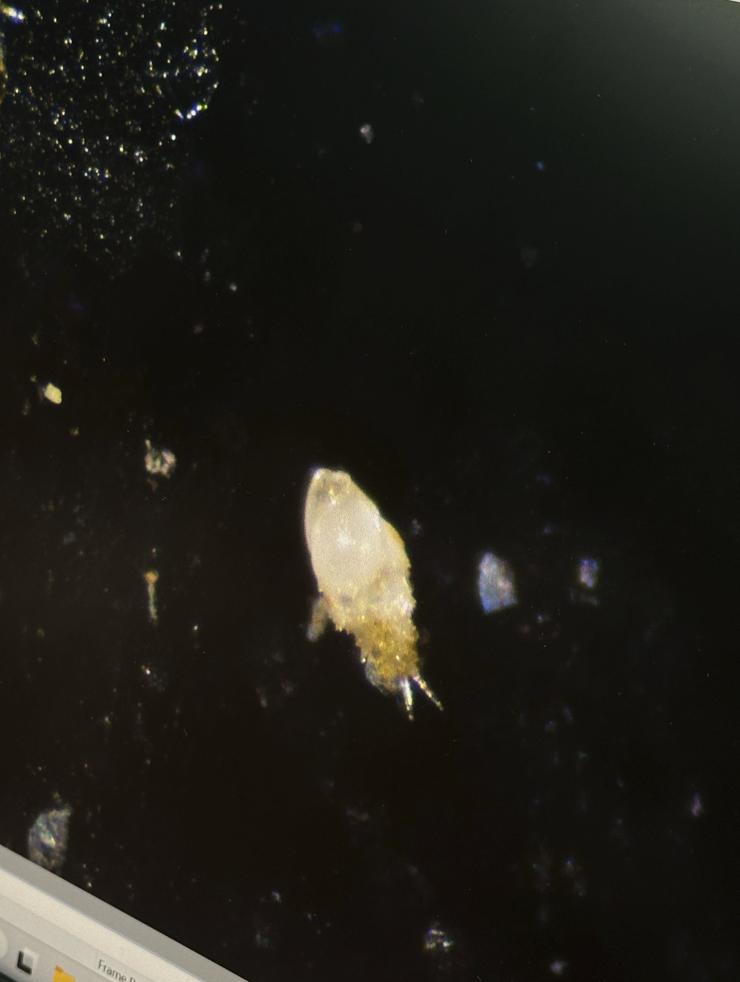
Today I woke up early to get back onto the day shift schedule so I could wash sediment without waiting for the CTD, which can only be deployed at night since Alvin takes up daytime hours. We washed the first few samples of a different core than yesterday that was much easier to wash. We were also able to find some of the foraminifera species we had been searching for. We scanned each centimeter for live foraminifera, but only found a few viable specimens. This process took us most of the day. In the evening I got to relax a little and watched Hamilton the movie with friends. 

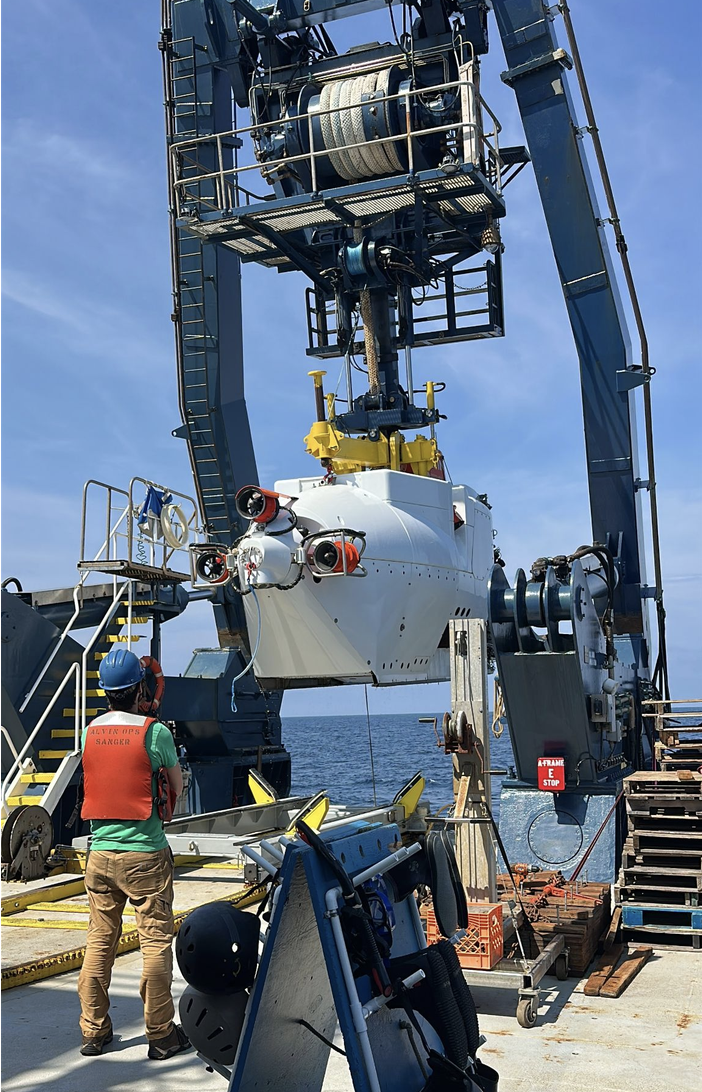
We also took a break in the middle of the day to watch Alvin come back up to the ship. The process is very involved. They send out a small life boat with swimmers to guide Alvin back to the Atlantis. It is then carried up by crane and placed on tracks that lead into a garage on the ship. There is a ladder near the edge of the tracks where the people in Alvin can climb down to get out. They usually get their pictures taken and we all cheered for the folks who went, emphasizing those who had their first dive. Before Alvin is put to rest in the garage, it needs to be cleaned off so the saltwater doesn’t linger and do damage.

Alvin coming back on deck after a dive.

Kaustubh Thirumalai
08/31/26

Today we had to spend time processing the cores collected the past couple of days. This involves washing the sliced cores and examining the samples for foraminifera, single-celled calcifying creatures that live in the ocean and deposit their shells in the sediment when they die. We ran into some trouble when washing the sediment, which needed to be washed into buckets to remove fine fraction. This was difficult for a couple of reasons. For one, we couldn’t wash the sediment into the sink because it could damage the drain so we needed to wash into buckets that we dumped overboard later. However, you cannot dump material overboard when the CTD is being deployed. Tonight, the CTD was deployed for several hours making it nearly impossible to find pockets of time in between deployments to dump. The first out of three deployments lasted four hours. Secondly, the mud we washed was very sticky and challenging to wash, meaning we had to use a lot of water, filling the buckets faster than usual. We also, unfortunately, didn’t find many of the species we were looking for.

Kaustubh Thirumalai
08/30/26

Today I woke up at 1pm fully ruining any resemblance of a sleep schedule. Alvin returned early which meant we could deploy the MC early as well. So we did. Around 4pm we were able to deploy the MC. Before then me and another grad student watched it get set up so we could learn. Unfortunately, that ended early because yet again, we were running out of time. Hopefully we will learn how to tie the knots to be able to help deploy soon. This time around, we had a successful launch and collected 2 good cores. While the machine was coming up, we rushed to eat dinner in 20 minutes. In the middle of the night, we got to learn how to deploy and bring up the MC instrument. It was a bit overwhelming with a lot of steps to learn, including how to successfully tie a bowline knot. Afterwards, I felt like a true sailor. While waiting for the MC to come up so we could hook it with giant sticks and guide it on deck, we got to see a school of squid right next to the boat swimming around.

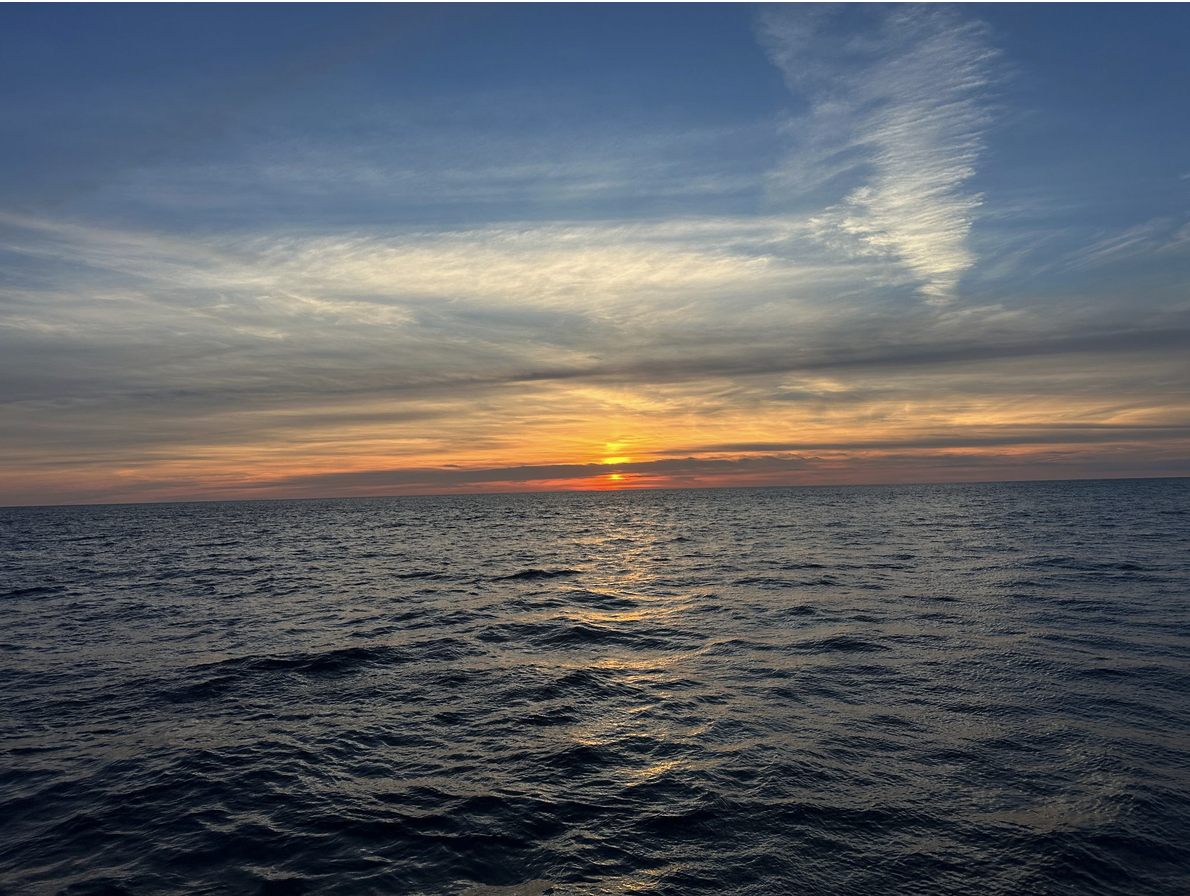
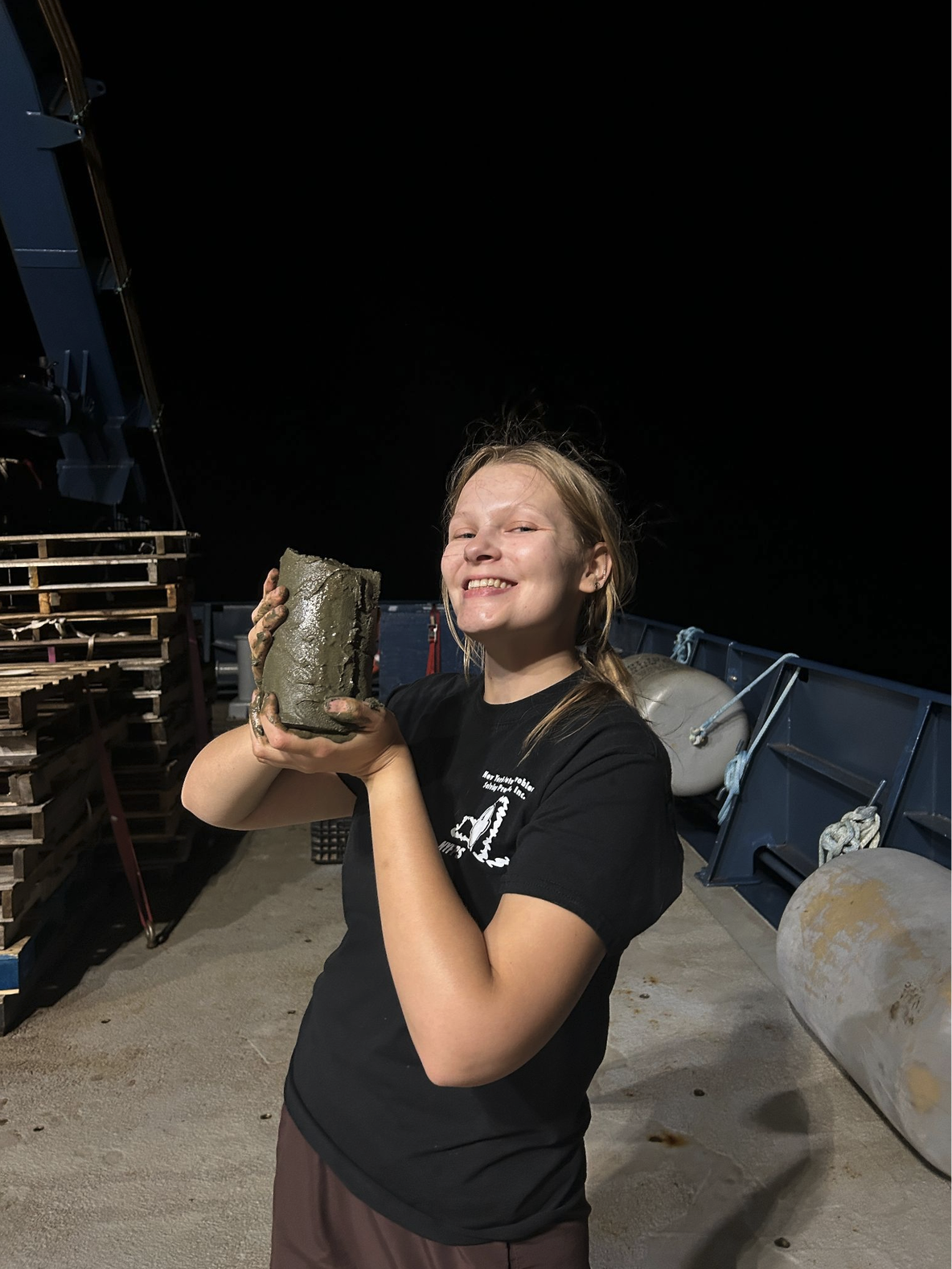
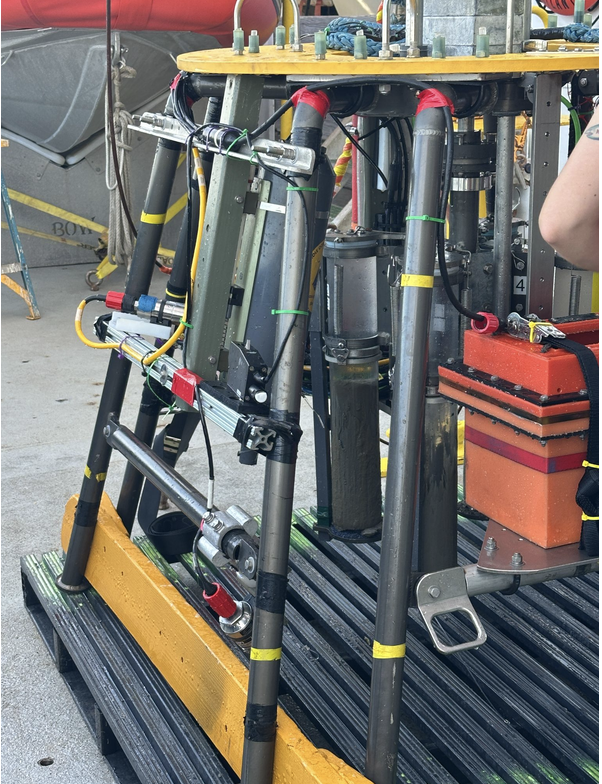
Next, came the messy part: processing the cores. We collected seawater from one core that we put in the fridge for analyses later. Then we put one core in the fridge (vertically so the mud wouldn’t slide around) and we sliced the second core by the centimeter. We repeated slicing for the core that was in the fridge. Luckily, we got to watch a beautiful sunset as we were working with the mud, making the experience more magical. I consider the beautiful scenery and successful sample collection the perfect way to spend my birthday.

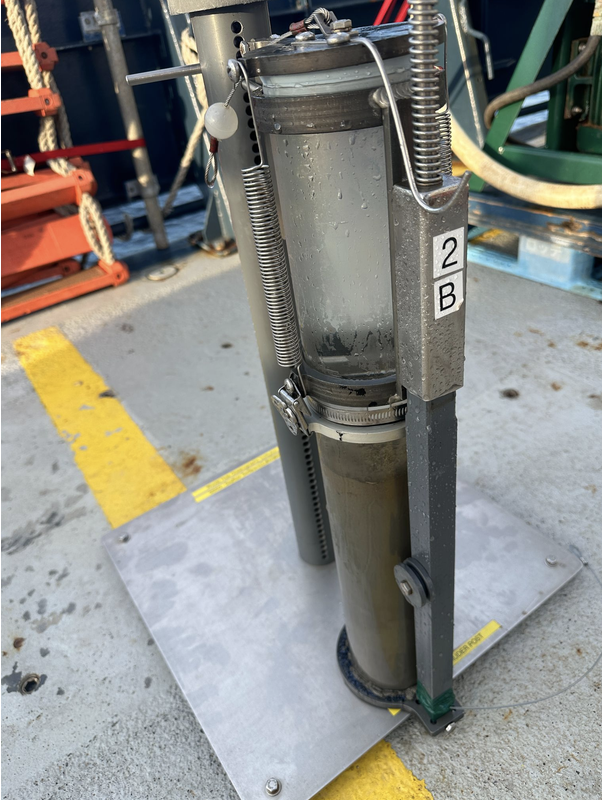
One core from the multiple corer that we then processed.

The multiple corer back on deck for sampling, this time somewhat successfully, with at least one good core.

Kaustubh Thirumalai
08/29/26

This morning I woke up a bit early so I could have breakfast before having to do fire and man overboard drills. At 8 am we all grabbed life vests and immersion suits before going to our designated stations. Lucky for me, anyone who hadn’t tried on an immersion suit before had to do so today to make sure they fit. These giant rubber suits were intense. You have to lay them out like a sleeping bag to put it on and the gloves look like lobster claws. To zip it up completely, it zips over your face and then you velcro over your eyes/forehead. 

Afterwards, I completed my Alvin training which included going inside the submarine! It was very exciting. You have to climb on top of the vessel to climb down a small ladder and scoot to your assigned seat. It is very small and only fits three people, but it has a lot of scientific equipment packed into it. It sort of looks like a cockpit of a plane as there are hundreds of buttons that each have their own importance. 

We officially set said at 10am EDT! Lots of people were out on the deck taking in the views as we left port, passing by massive military ships. Dolphins escorted us out of Chesapeake Bay towards open waters.

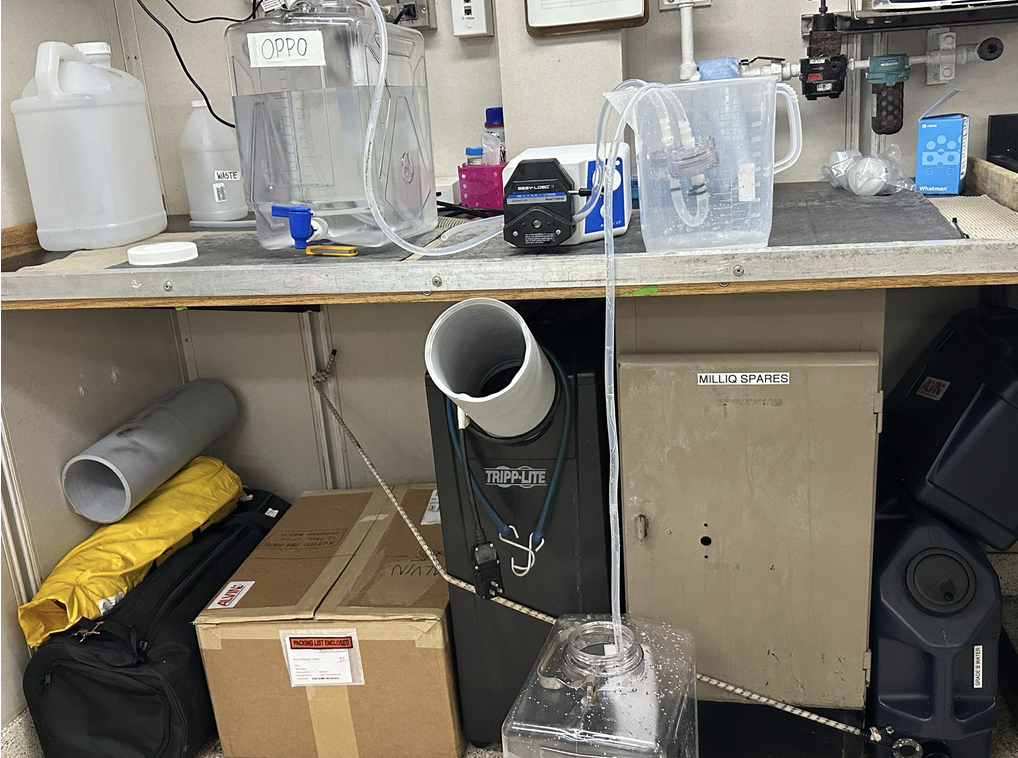
Later on, I worked on filtering water with my colleague. Unfortunately, there were a lot of kinks in our plans. First, our original filtration device had hydrophobic filters (given to us by accident) so they would not work for filtering seawater. Then it turned out that we were using the wrong mesh sized filter once we found another way, so we had to refilter our partially filtered water which was a bit frustrating and very time consuming. Since we needed to use the smaller filter, the water pressure kept growing as it was trying to get through the mesh and occasionally ‘exploded’ by the plumbing popping off the filters.

It was our first night shift since we set sail and we had the chance to deploy tonight! It was a very long day and night. By the time we reached our destination to where we wanted our samples from, it was about 1am. We then had several issues with trying to deploy the multiple corer machine we were using to collect samples. The bungee that helps stabilize the machine from the top of it to the rope that the crane uses to move the multiple corer (MC) up and down kept breaking. We were fighting time as we needed to deploy by 4am in order to be out of the way for the Alvin rover to deploy first thing in the morning. We were able to finally fix the bungee issue, with 20 minutes to spare. However, when we deployed, the hooks that trigger the tubes to close must have been hooked on incorrectly because we kept losing our samples. At about 5:30am, we gave up and decided to try the next day.
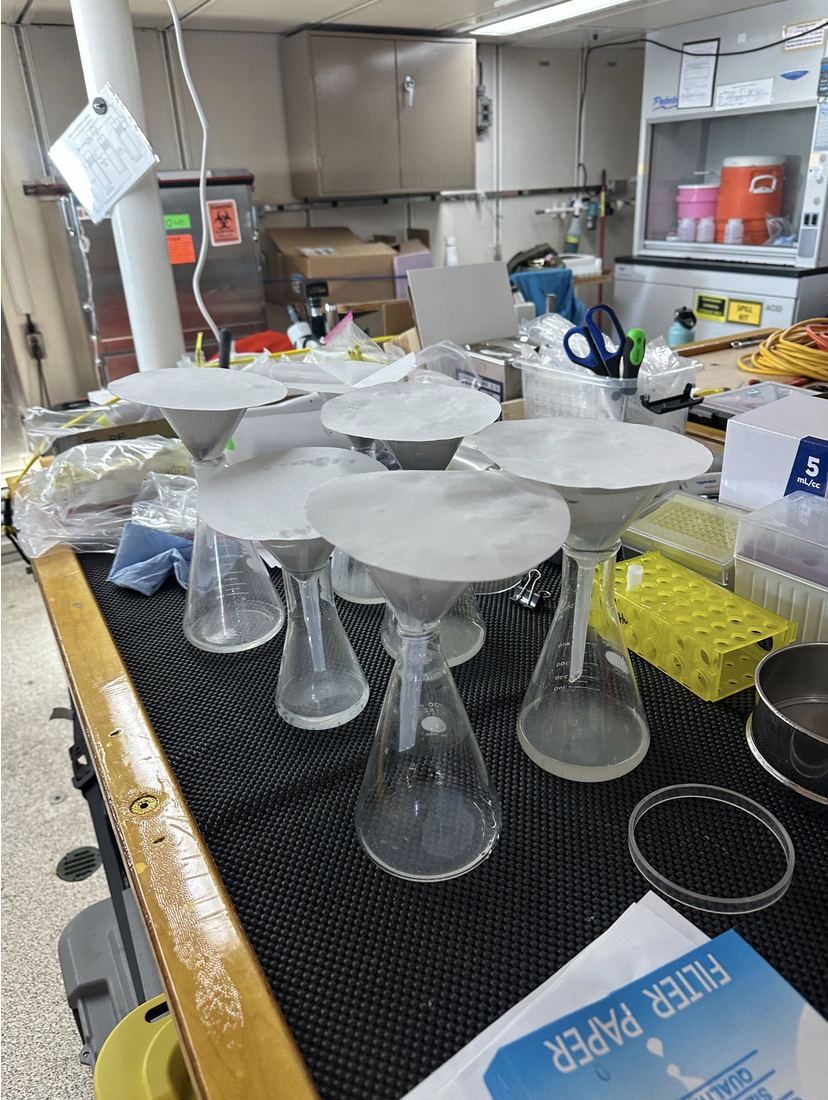
Our oh so fancy water filtering station designed to pump seawater (on left) through multiple filters and into the container on the ground (it took forever). The beaker is simply there to catch leaking water from outside the filters.

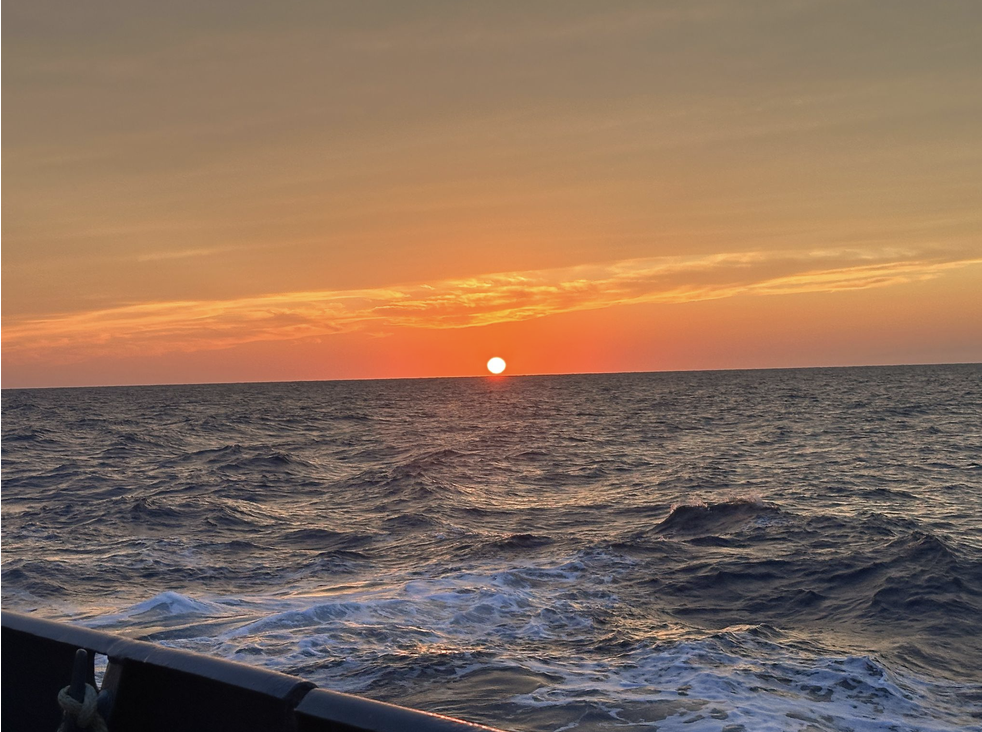
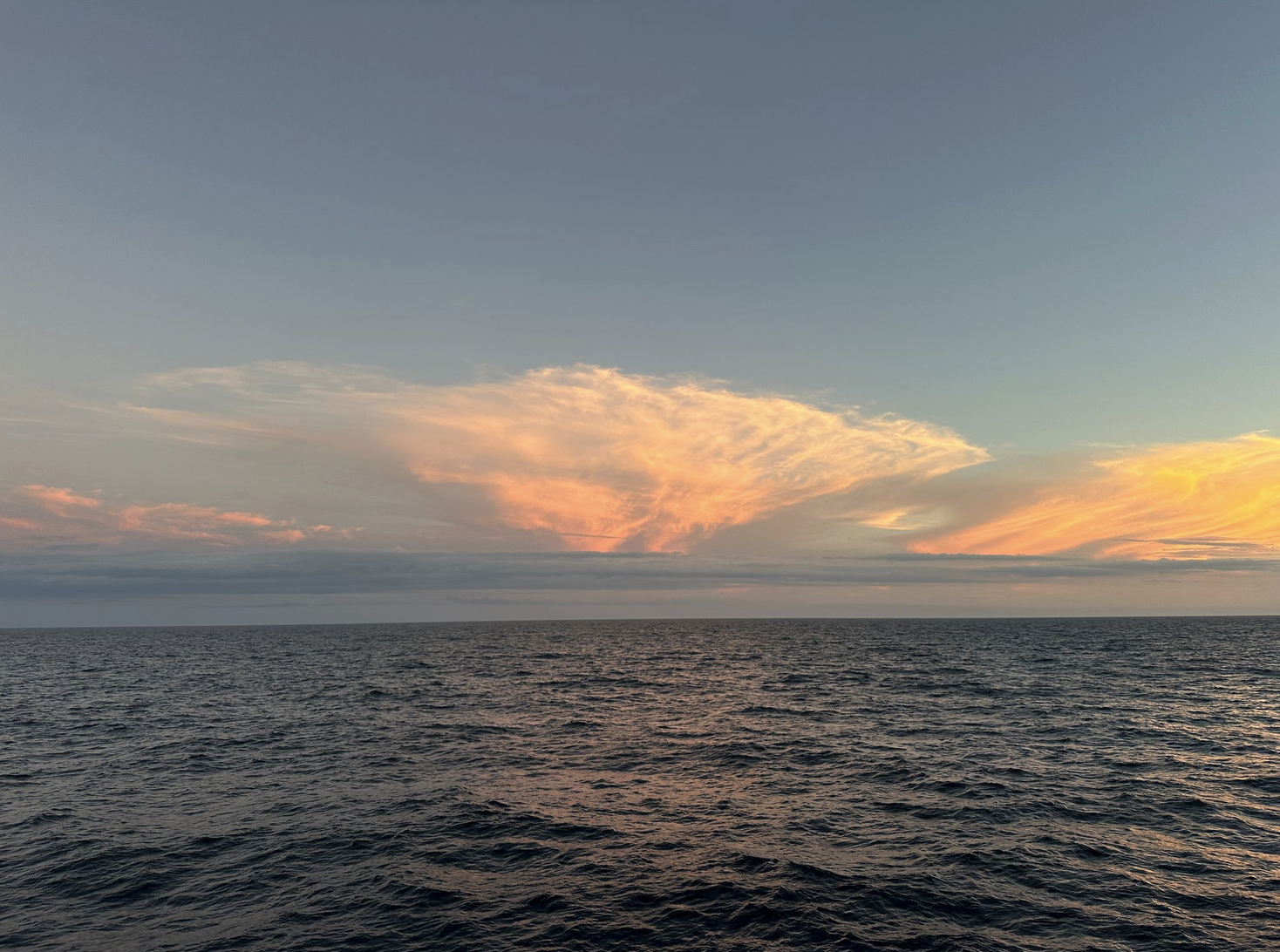
A beautiful sunset as we approached our coring destination.

Kaustubh Thirumalai
08/28/26

Today was a pretty easy day. I got to sleep in which felt wonderful given the jet lag. I went over scientific protocols with my supervisor to get a better understanding of what we were actually doing. A bit overwhelming, but very helpful. We will be some of the first people to get data from this cruise so we have to make sure we are ready to go (exciting!). I’ve never been on a cruise before or have worked with these types of samples, so I am nervous about messing up the procedure, but excited to try something new. 

We had an orientation after lunch to go over safety procedures on the ship given a variety of scenarios. One of which was geared towards mainly students, who were housed in the “forward berthing”. This meant that we only had one stairwell in and out. In case of an emergency, we were shown where the ladder was to climb out and all had to do it. It is a little tight at the top so it took me a second to get my knees oriented. 

Afterwards I did some work in the library. The comfy chairs and freshly stalked snacks made this a more pleasant experience. My team and I decided to have one last meal on land before we set sail. We had sushi downtown and ended the night with an ice cream back on ship. 

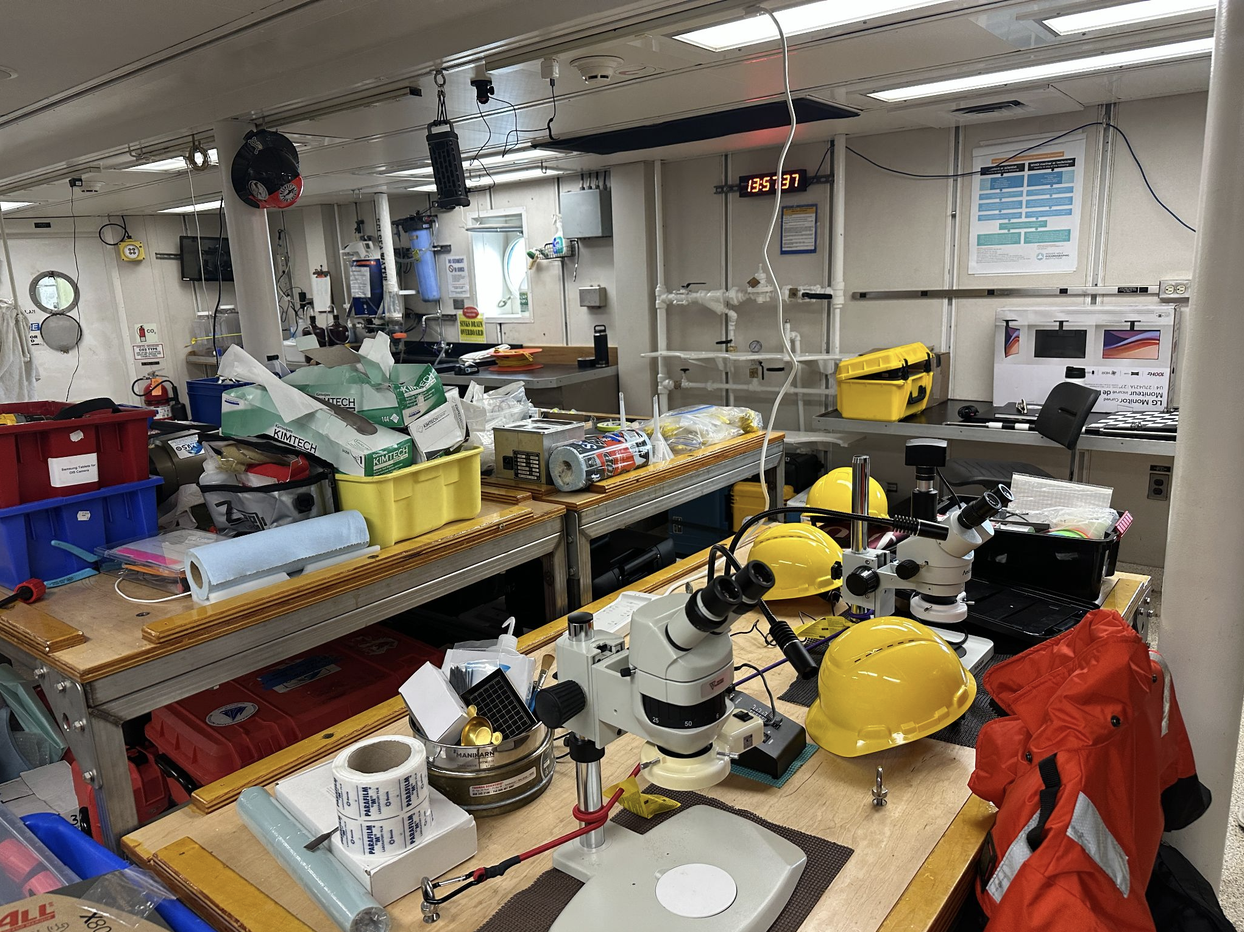
Hydrolab set up for picking foraminifera:

Kaustubh Thirumalai
08/27/26

I got in late to Norfolk last night so I was super tired this morning, but excited to get settled on the RV Atlantis. I left my very comfortable hotel room and met my team downstairs. Me and another grad student had to Uber because the rental car had too much equipment in it to hold two more people. When we got to the military base, we had to wait in line outside to go into this very small room and receive our visitor badges. The sun and the high humidity along with the weight of our bags made this a tad uncomfortable. With our new badges, we were able to scan to get onto base and  walk through to where the ship was docked. It was a bit chaotic. The RV Atlantis is Navy owned, but operated by WHOI. It is the only ship that houses Alvin, a “human occupied submersible”. It is one of the largest research vessels owned by the U.S. and yet, it looked like a toy boat compared to the massive military ships next to it preparing to leave port. These ships had to be at least twice the size of the Atlantis. The closest ship had a lot of construction happening on board leading to a lot of activity in the surrounding areas to navigate. Even the Atlantis was busy having forklifts bring luggage and lab equipment on board and I saw a crane carrying a NSF lab on board. 

I was able to drop my luggage off in my room. It is a three person room with a bunk bed and one pull-out from the wall. Luckily, I have nice roommates to make the crowded experience better. We each got a dresser and a small closet to put our stuff into. The bathroom has a small shower and toilet that connects to another bedroom so it locks on both sides. It has a heated lamp which is quite luxurious. 

After settling in a little bit, we unloaded the rest of our stuff starting with the lab equipment. Maybe the most challenging part was figuring out what space we could claim in a shared lab. We put non-skid mats on all of our tables, bolted down our microscopes, and bungeed any boxes/crates that we could to the walls. We needed to secure everything on the tables and also the ground to make sure it wouldn’t slide once we are sea-born. 

To end the day, we got to get off the ship and have a nice Italian dinner.

Kaustubh Thirumalai